
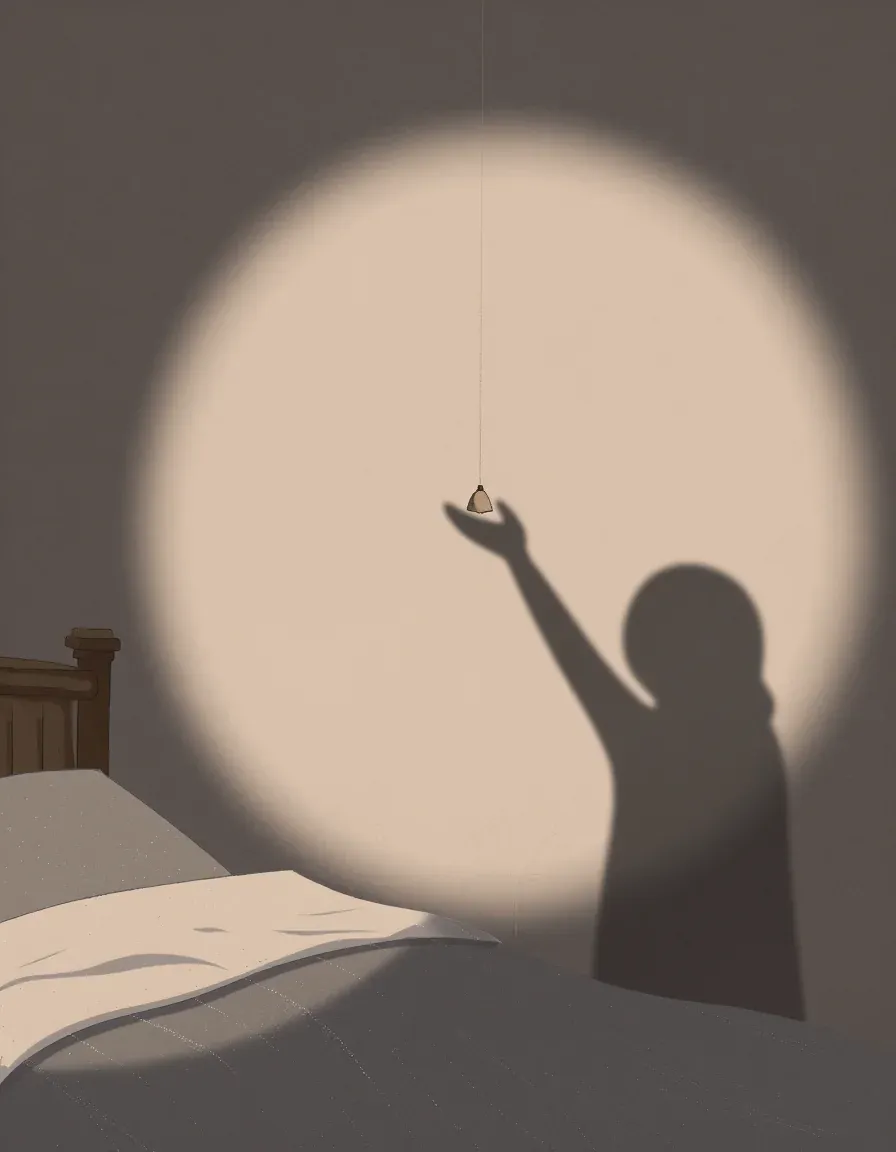
There’s a nice notebook in a drawer somewhere in your house. It has four entries: three consecutive ones from January, and one from a Tuesday in April that opens with “okay, this time for real”. You know this because it happens to everyone.
The usual explanation is discipline. You weren’t consistent, you never made it a habit, you lacked willpower. It’s a convenient explanation because it requires changing nothing about the notebook: the fault is you.
But when the same object fails the same way in nearly every pair of hands, the problem probably isn’t the hands.
What actually happens when you open it
Writing in a blank journal isn’t one task, it’s three, and all three land at the worst possible moment: the dead time before sleep.
- Decide what to write about. About your day, about the last few months, about your entire life. The search space is infinite and there are no clues.
- Decide whether that deserves to be written down. This is where the internal editor shows up, already judging the sentence before it exists.
- Write it well. Because at some point you decided, without deciding, that what goes in a journal has to be up to standard.
Three hard decisions in exchange for zero immediate reward. Nobody sustains that for long, least of all at half past eleven at night.
Removing the first decision changes almost everything
If something or someone tells you what to write about, the task stops being “produce content” and becomes “answer this”. And answering is a far cheaper operation than inventing: your head already knows how, it’s been doing it in every conversation you’ve ever had.
That’s why prompts like “what surprised you today?” work. Not because the question is especially wise, but because it narrows the field. And it’s why ambiguous things work even better: a loose word, a shape that isn’t anything in particular. A direct question asks for a correct answer; an ambiguous card can’t ask you for anything, because on its own it doesn’t mean anything.
And the clock takes care of the other two
The internal editor needs time to work. Give it thirty seconds and it rewrites your sentence; give it two minutes and it convinces you tomorrow would be better.
A visible sixty-second timer isn’t a productivity technique, it’s a way of getting there before the editor does. When time is up it’s genuinely up, and whatever got written stays as it is. There’s no good version to chase, so there’s no reason not to start.
What comes out isn’t literature. It’s four crooked words you wouldn’t show anyone. Which is exactly why they’re the only ones that went through no filter at all.
It doesn’t have to be important
The last trap of journaling is believing each entry has to be worth something on its own. It doesn’t have to be worth anything. One loose note from a Thursday says absolutely nothing.
The value shows up when there are forty of them and you read them in a row, and you notice the word “tired” appears nine times and you hadn’t clocked a single one. No individual entry was the data. The repetition was the data.
So the bar for writing today can be extremely low, because today isn’t where the meaning lives. Today you just have to leave a mark.